15 Days Price Change

 URVASHI TOTLA
MBA graduate and CFA Level II cleared, with NISM certifications in Series VIII and XV. Ski... MBA graduate and CFA Level II cleared, with NISM certifications in Series VIII and XV. Skilled in Financial Modeling, Valuation, and Portfolio analysis, with a strong interest in equity research and investment strategies. Read more
Summary
India’s solar boom hit a roadblock as 43 GW of projects stalled due to missing storage, weak last-mile grid infrastructure, and auctions done without confirmed buyers. With DISCOMs demanding evening power and outdated networks unable to absorb excess daytime supply, plain-solar projects have become unviable. The government is now rebooting the system with mandatory battery storage, PPA-first rules, and cleanup of stuck projects. The solar story isn’t over—it’s simply evolving, and the winners will be those who adapt to a storage-led future.
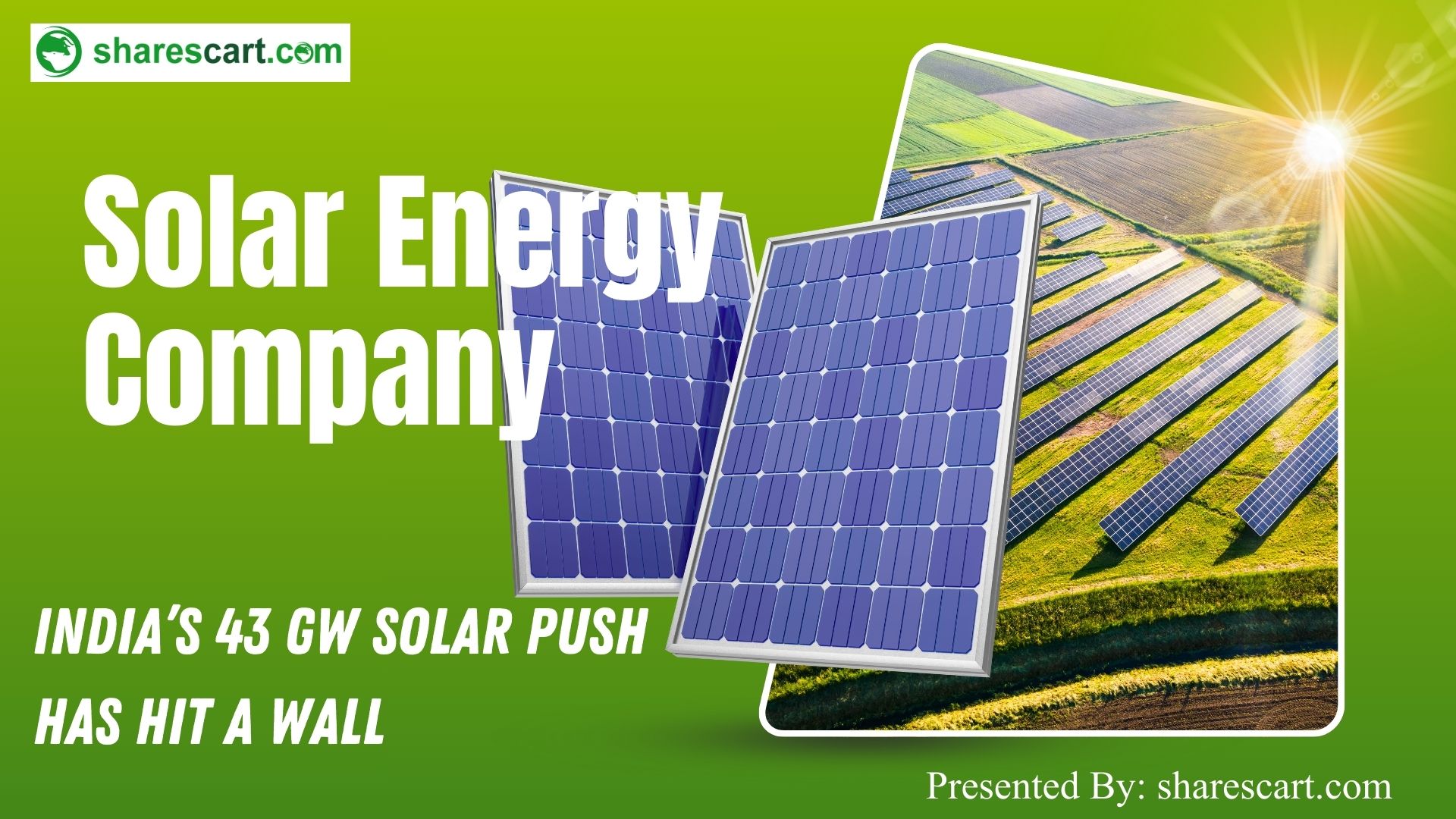
During the past two years, 88 gigawatts of renewable and solar projects were auctioned by government agencies. The bidding spree by SECI, NTPC, NHPC, and SJVN did not stop as it had granted project after project to the developers who were keen on establishing the clean energy future of India.
On the one hand, there are 43 GW of those projects that are stalled today. No power purchase agreements signed. No construction happening. No revenue flowing.
And it is not numbers on paper. Companies are languishing. Solar companies and EPC companies, like Waaree Energies and Vikram Solar that had placed large bet on this boom are now seeing their stocks stagnate. Shareholders that deposited money in solar EPC firms are getting poor returns.
The only question that everyone asks: What went wrong?
The solution is that three essential failures were left unaddressed by anyone as projects were auctioned. Let's break it down.
Here's the fundamental issue. The 43 GW of stuck projects are mostly plain solar projects, without a battery storage system (BESS).
These initiatives produce power during 10 AM-3 PM when the sun is the brightest. Sounds great, right? Not really.
Most of the states are already supplying surplus electricity during the time between 10 AM and 3 PM. The demand in the industry is average. There is low residential consumption. Solar power is flooded to the grid.
A number of DISCOMs are in fact paying their neighbors to accepting excess power during these hours. Others are even cutting their solar production, requesting the plants to close down in the short run since they have nowhere to dispose the generated electricity.
But this is what the DISCOMs are crying out after, Power between 6 PM and 10 PM.
It is the time all people get home after work. ACs get switched on. TVs start running. Dinner is being cooked. Peak demand over runs the grid.
And solar production at this period? Zero.
So DISCOMs are saying developers: "We do not want electricity between 10 AM-3 PM. Attach battery storage to your projects, should you wish that we sign PPAs. BESS, with help of which you can save the electricity in the morning and sell it in the evening peak time. In the absence of BESS, we are not interested.
But there's a catch.
The costs of the project may rise by 40-50 % with the addition of battery storage. A single-planned solar project at 2.40 per unit will turn out 4.00-4.20 per unit with battery storage of 4 hours.
At this rate, DISCOMs will not enter into PPAs. People claim the price increment is excessive.
Developers are stuck. DISCOMs desire batteries but would not pay them. Battery additions by the developers cannot be made without increased tariffs. Deadlock.
The second issue is infrastructure. In particular, the grid connection between your house and DISCOM.
We shall know how electricity moves.
When a solar project in Rajasthan produces energy, it must be transmitted to the residences in, say, Madhya Pradesh. The adventure occurs in phases:
Stage 1: Interstate Transmission (The Highway)
The Power grid corporation of India (PGCIL) has huge transmission lines of 765 kV linking the states. Imagine these as national electric highways.
This part works fine. There is capacity in interstate transmission. The load can be carried by the network of PGCIL that covers 495, 000 circuit kilometers.
Stage 2: Intra-State Transmission (State Roads)
When power gets into a state, state transmission utilities reduce the voltage and deliver it to the district substations over 220 kV, 132 kV and 33 kV lines.
This part mostly works too.
Stage 3 Distribution Network (Local Streets).
Here is the point of breakdown. Power is sent to individual homes and businesses via the 11 kV distribution lines that pass through the villages and towns on poles.
This infrastructure is archaic. The distribution networks of most of them were set up 20-30 years ago at much lower capacity. They are just unable to take in more solar energy that is being produced.
The symptoms are manifested everywhere:
Voltage variance in house.
Frequent power tripping
Transformer failures
Poor power quality
To fix this, DISCOMs need:
Eliminates previous 11 kV lines and install new 33 kV lines.
Increase capacity of upgrade transformers 25 MVA to 100 MVA.
Install smart grids and metering.
Build new substations
The cost? Millions of crores each state. The time needed? 10-15 years.
This type of money and time is lacking with DISCOMs. So they are not accepting PPAs, citing the reason that their grid cannot physically accommodate additional cannon of solar power.
Although the process of interstate transmission might be perfect, the electricity will not reach consumers when the last-mile distribution system is disrupted. It is as though creating a high way in Delhi to Mumbai and having pothole village roads at the end.
The design of the system is the third issue.
The former procedure resembled the following one:
Step 1: auction winner receives Letter of Award (LOA) by developer.
Step 2: Approval of grid connectivity obtained by the developer at CERC.
Step 3: Preliminary work, land purchase, equipment orders begin with the developer.
Step 4: Developer appeals to DISCOM to provide PPA.
Step 5: DISCOM declines and requests revisions.
Step 6: Project stuck
Notice what's missing? None of the PPA conditions prior to auction. There is no indication that DISCOMs desire this power. No verification on the aspect of storage. No check of last-mile grid capacity.
LOA and grid slots were awarded to developers on the basis of winning bids and it was assumed that DISCOMs would eventually sign PPAs. That supposition came disastrously true.
The government has now come to understand that the system is faulty. And this is what they are now requiring:
Change 1: Storage Is Mandatory
Battery energy storage systems should be incorporated in the future projects. No more plain solar. You desire a PPA, then your project must have BESS to supply power in the evening peak periods.
This change is already reflected in the data. So far, 5.8 GW of the 90% issued in FY26 has storage. Only 10% is standalone solar.
Change 2: PPA Before Grid
The new process requires:
Step 1: DISCOM declares: X GW of solar + storage power is required.
Step 2: Auction occurs of confirmed demand.
Step 3: Winner has to sign PPA with DISCOM first.
Step 4: It is only upon receiving grid connectivity approval.
Step 5: It is only after this that you start construction.
This gets rid of speculation. They are constructed only when DISCOMs desire to have the projects.
Change 3: Grid Slot Auctions
CERC is offering the 31.8 GW of unutilized grid connectivity to new bidders with assured PPA. No further holding slots of projects which might never be built.
Change 4: 12 Month Cancellation Rule.
LOAs not executed after 12 months may now be cancelled. It allows agencies to have legal protection in order to cancel stagnant projects.
The reason why Solar Stocks are suffering.
This is the reason why Waaree Energies, Vikram Solar, and other solar EPC companies are performing poor.
Last 2-3 years the government was the majority buyer via SECI, NTPC, NHPC and SJVN. These agencies gave out 88 GW of projects.
The capacity increased in the hands of solar manufacturers in expectation of huge demand. They put money into new production lines. They ordered raw materials. They hired workers.
Then 43 GW got stuck.
Orders that were to arrive? Delayed or cancelled. Revenue that was projected? Not materializing. What projects are supposed to be under construction? Frozen.
Solar EPC caught in the crossfire is Waaree, Vikram and others. They made a boom capacity which has not been achieved. Their order books are not as thick as they should be. Investors are disappointed.
It is the reason that solar stocks are not performing well in spite of the ambitious plans of renewable in India. The targets exist. The auctions happened. But execution itself is paralyzed.
The positive aspect: It is a temporary phenomenon.
The government has defined the issues and is fixing them:
Storage of batteries in all new projects which is a mandate.
PPA-first pregrid allocation.
Slow but sure grid upgrade programs.
Stuck project cleanup by cancellations or by conversions.
The bad news: It will hurt to change.
The 43 GW of projects are being canceled or converted to expensive storage.
The demand of solar equipment will be controlled at the next 1-2 years.
Manufacturers will be subject to pressure of margin.
Others of small developers will be bankrupt.
However, the market is expected to level off by 2026-2027. Storage-based new auctions will restart. DISCOMs will begin to make PPAs around the clock power. Slow grid upgrades will be made.
In the short term (12-18 months) Solar EPC firms and manufacturers will still be in a struggle. The performance of stocks will be subdued.
Medium term (2-3 years): firms that transition into storage-integrated solutions will win. The ones who are left with uninteresting sun power capability will lose.
Manufacturers of batteries (demand soaring)
Combined providers who are offering solar+storage+transmission.
Infrastructure companies related to the grid.
Deep-pocket large players (Adani, Tata, ReNew).
Pure-play solar firms without any storage facility.
Small developers that are not able to afford battery integration.
Projects in the PPA stage of non-storage.
India has auctioned 88 GW of solar projects in two years. 43 GW is not taking off due to:
Problem 1: Plain solar with no batteries produce power on the days when DISCOMs do not need electricity (10 AM-3 PM) and provide none on the days when they are in dire need of electricity (6 PM-10 PM).
Problem 2: Interstate transmission is okay, but the grids used in last-mile distribution are damaged and cannot absorb any additional solar.
Problem 3: The previous system accepted projects without verified purchasers. None are subject to any PPA prior to grid allocation. No storage mandate.
The fix: Mandatory BESS. PPA-first approach. Grid slot auctions. Cleanup of stuck projects.
Stock implications: Waree and Vikram, the solar companies, are also being hit due to the fact that theirs is the largest customer (government agencies) who have got 43 GW stagnant. This is short lived and the process will be agonizing.
The Indian solar legend is not finished. It is simply passing into a more sophisticated, less idealistic stage in which storage has become a requirement, grids have to be refined, and the speculative auctions with no buyers will no longer be tolerated.
To investors, the word is simple: The solar boom is not cancelled. It's being recalibrated. The victors are those who will adjust to the new reality of storage-integrated projects. Victims will be those who will remain in the old plain-solar model.
This reset marks the start of a more mature renewable cycle. For those exploring unlisted opportunities, Sharescart provides a window into companies ready to thrive in India’s next solar chapter.












Independent Research Powered By - Actionable data

Comprehensive Equity and Strategic Research Report...
February 2026
Motilal Oswal Home Finance: Best-in-Class Asset Qu...
February 2026
Hero FinCorp: From Two-Wheeler Finance to NBFC Con...
February 2026
boAt After the Boom: Consolidation, Comeback, or C...
February 2026
API Holdings Ltd – India’s Largest Digital Healthc...
February 2026
Arohan Financial Services: A Digitally-Driven Micr...
February 2026