Sharescart Research Club logo
AVPL 49 (0%)Bira 168 (-6.7%)Capgemini Technology 11000 (0%)CIAL 455 (-1.1%)GFCL EV Product LTD 46 (-4.2%)Greenzo Energy Pvt Ltd 635 (0%)HDFC Securities 9500 (2.7%)Honeywell Electrical Devices and Systems 8500 (0%)HPX India 33 (0%)ICEX 3.75 (0%)Incred Holdings 165 (0%)Lords Mark Industries 80 (0%)Motilal Oswal 12.95 (0%)MSEI 3.55 (29.1%)NSE 1950 (1.3%)Onix Renewable 68 (-5.6%)Orbis Financial 435 (-3.3%)OYO 27 (-3.6%)OYO Assets 22 (-12%)Pharmeasy 6.5 (0%)PolicyX 62 (0%)Polymatech Electronics Pvt Ltd 66 (-2.9%)Royalcare Super Speciality Hospital 148 (4.2%)SBI Mutual Fund 685 (1.7%)Signify Innovations 1150 (0%)Spray Engineering Devices 258 (-3.7%)Zepto CCPS 176562 (0%)

15 Days Price Change

Zepto in Transition: Explosive Growth with Execution and Governance Tests

Zepto in Transition: Explosive Growth with Execution and Governance Te... Zepto in Transition: Explosive Growth with Execution and Governance Tests Read more

Manika Bhalla Manika Bhalla
Manika Bhalla

Economics Honors graduate and CFA Level ll cleared, equipped with strong analytical skills... Economics Honors graduate and CFA Level ll cleared, equipped with strong analytical skills and a solid foundation in finance. Experienced in financial modeling and valuation, with a keen interest in equity research and investment analysis. Read more

17

Articles

7

Likes

6

Followers
17 Jun, 2025
Zepto
Exclusive Access to Unlisted Shares
  • Early Entry Advantage
  • High-Growth Potential
  • Trusted & Secure

Summary

Zepto has rapidly scaled into one of India’s leading quick-commerce players, with revenues growing over 30x between FY22 and FY24. While the company remains loss-making due to its growth-first strategy, declining losses as a percentage of revenue signal improving unit economics. Zepto leads peer Blinkit on scale but trails on cost discipline and governance, as highlighted by its FY24 qualified audit opinion. Backed by strong investor funding, Zepto remains a high-growth, high-risk business, with long-term success hinging on converting scale into sustainable profitability and stronger governance.

Company Overview

As India's quick commerce market continues to grow rapidly, it has also become increasingly competitive and therefore requires large amounts of capital to be able to support businesses operating within this space. The primary focus of the new and rapidly growing industry is to provide consumers with ultra-fast and convenient delivery of their daily essentials. Zepto is one of the most successful participants in this rapidly growing sector of the marketplace and is quickly becoming one of the top competitors within the quick commerce industry.

This provides an overview of the financial and governance aspects of Zepto. The purpose of the analysis is to provide a clear view of Zepto's growth path, long-term viability, maturity of governance practices, and forecast for the future based on empirically derived statistical data rather than informal market speculation regarding growth or success.

Kiranakart Technologies Pvt Ltd was established in 2020 to participate in quick commerce by delivering groceries and essential everyday items directly to consumers using the internet. Zepto has built its model on technology and is structured for last-mile delivery within minutes by establishing a system for managing inventory as well as a network of dark stores. The main component of Zepto's inventory-based delivery system is that dark stores are where the products are held for the customer. The ability to store products in dark stores gives Zepto greater control of how quickly it can ship and deliver each customer's order. However, by utilising dark stores, Zepto will need to make major capital investments in warehouses, the purchase of inventory, and its delivery network.

Beyond the retail delivery component, Zepto is also expanding into warehouse distribution services, thus creating an opportunity to increase its supply chain efficiency through increasing its ability to scale. With Zepto's rapid growth, customer acquisition and market presence, Zepto's financial success is an excellent example of the financial returns generated by a venture-backed company with a hyper-growth trajectory.

Corporate Structure And Ownership Framework

Zepto has established a corporate structure consisting of three levels, which enables centralised management over the company's operations, capital funding, and economies of scale.

The highest level of this corporate structure is the holding company, Kiranakart PTE Limited (Singapore). This company owns 99.99% of Kiranakart Technologies Private (India). As the holding company, Kiranakart PTE Limited controls the overall long-term strategy, capital allocation, and equity funding (through the above-mentioned companies) and has provided financing support to Kiranakart Technologies Private so it continues to operate successfully in India.

At the lowest level is Kiranakart Technologies Private (India), which is the operating company of the Zepto brand. This company is responsible for operating the Zepto platform (dark stores) and last-mile delivery service, as well as managing customer service operations for both retail and e-commerce customers.

In addition to these two companies, there is also Kiranakart Wholesale Private (a subsidiary and wholly owned subsidiary of Kiranakart Technologies Private) that is focused on purchasing goods in bulk for wholesale distribution. Kiranakart Wholesale Private is designed to improve supply-chain efficiency and thereby increase margins through increased buying power. It is common for venture-funded businesses to operate in this manner, as it facilitates strategic control by the parent/holding company and financial dependence on the parent/holding company.

Indian Quick Commerce Overview and Economic Impact

India's Quick Commerce Industry is characterised by a high frequency of small quantity orders at low prices, and extremely low margins, which means companies are competing aggressively to grow their share of this market. This means companies have to focus on building logistical density (lots of stores close together), dark stores (warehouses), and marketing efforts to remain competitive in the market. Achieving profitability does not come from selling a single order, but rather from the scale, repeat usage, and the efficiencies created through operational excellence.

Due to these characteristics, the Indian Quick Commerce Industry tends to favour companies that have large amounts of available capital and are willing to invest in and support their operations for an extended period of time as they grow and optimise their unit economics. Therefore, Zepto should be evaluated relative to the industry context, as it is pursuing growth while accepting that it may incur losses in the near-term.
Financial Overview

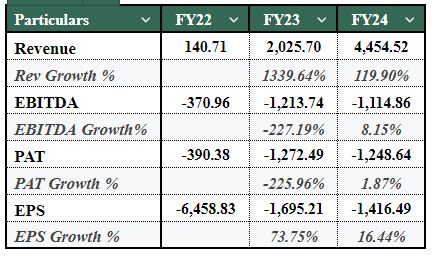
  • The revenue of Zepto has seen a huge increase in a short amount of time, from ₹1,407 million in FY2022 to ₹20,257 million in FY2023. In FY2024, the revenue doubled again to reach ₹44,545 million, representing a more than 30x increase in the 2 years from FY2022 - FY2024 and 120% year on year growth in FY2024 alone. The rapid geographic expansion of Zepto has allowed for increased order volumes and adoption by customers. The sustained triple-digit growth of Zepto highlights its ability to gain market share in a very competitive environment.
  • Zepto has had a tremendous increase in revenues but has continued to be unprofitable. This is not unexpected given that Zepto has a capital-intensive business model. Zepto's loss has grown from ₹3,904 million in FY2022 to ₹12,725 million in FY2023 due mainly to aggressive expansion plans. FY2024 was an important turning point for Zepto. In FY2024, while revenue grew by 2 times, Zeppto's losses remained relatively flat at ₹12,486 million. This has greatly lowered the loss percentage on revenue dramatically from 277% of revenue in FY2022 to 28% of revenue in FY2024. This trend indicates that Zepto is finding operational leverage and is becoming less loss-producing with each incremental revenue.
  • Zepto is a business that relies heavily on purchasing goods for resale. For FY2024, Zepto spent ₹38,221 million to purchase stock for resale. Other key costs for Zepto pertain to logistics and warehousing, as well as advertising, technology, etc., which appear under the category of Other Expenses at a total of ₹16,621 million.
  • Employee Benefit Expenses for Zepto have increased to ₹4,263 million, which reflects a commitment and investment in operations and technology staff. Today's depreciation costs and finance costs have grown to match infrastructure expansion, which is reflective of a business strategy that invests heavily in cost structures that allow for rapid growth and expansion, rather than short-term profit optimisation.
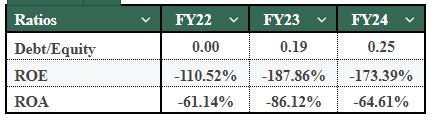
  • While Zepto has experienced a very high rate of revenue growth from FY2023 through FY2024, Zepto's balance sheet has continued to be relatively stable. Total assets were ₹21,326 million while equity remains approximately ₹6,430 million. The stability of the balance sheet, combined with the rapid growth of revenues, indicates an improvement in the efficiency of asset turnover for Zepto. However, Zepto also has a high amount of liabilities and, through March 2024, had accumulated losses of ₹29,128 million, which underscores the business's reliance on external financing to sustain its operations.

    Zepto is considerably cash flow-negative due to operations. In FY2024, operating cash outflows (as reported) were ₹11,315 million, and continuing losses have been financed through equity funding, with ₹12,495 million of this being raised in FY2024.

The Company continues to prepare its financial statements on a going concern basis. This is primarily reliant upon a formal commitment from its timber-related Singapore Holding company to provide continuing financial support to the Company. At the end of FY2024, Zepto had a positive cash position (positioning) of ₹3,983 million; however, Zepto's continued long-term survival is directly dependent on the ongoing confidence of its investors and the availability of liquidity.

Governance and Audit Observations

Auditors provided unqualified audits (opinions) on the consolidated financial statements for the years ending FY2023 and FY2024; this indicates that the Company’s financial statements represent a true and fair view of the Company's financial conditions, according to Indian Accounting Standards.

In FY2024, through the course of the audit, a major governance issue arose and was identified by the auditors as a qualified opinion regarding the internal financial controls. The audit discovered material office weaknesses in the information (IT) general office controls with respect to user access control, system alterations and IT operations.
Comparison of Peers

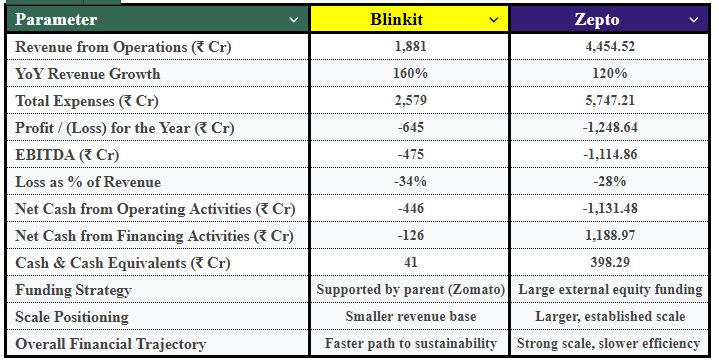
Due to the lack of available standalone financial data from the quick-commerce space in India, Blinkit (owned by Zomato) is the only company that is comparable for comparison purposes to Zepto, since both companies operate using an ultra-fast delivery model and dark-store infrastructure to provide delivery services for customers while focusing on scaling the business rather than focusing on making a profit in the short term. However, they differ materially regarding scale, level of efficiency and the types of funds utilised to support their business.

  • Regarding scale and revenue, Zepto is operating at a much more significant scale than Blinkit; during FY2024, Zepto reported ₹4,454.5 Crore in revenues compared to Blinkit's ₹1,881 Crore (2.3 times the amount of revenue for Blinkit). This indicates Zepto has a more extensive city network, a more substantial number of orders and more penetration within the marketplace.
  • While Blinkit had substantially higher growth year over year (YoY) at 160%, Zepto's YoY growth rate of 120% is still exceptionally robust, given the larger base. Although Blinkit has a higher percentage growth, Zepto is substantially larger in terms of revenue generated in total.
  • Due to Zepto's greater scale of operation, Zepto has a significantly larger cost structure. During FY2024, Zepto incurred total costs of ₹5,747 crore while Blinkit incurred total costs of ₹2,579 crore. Zepto's significantly larger cost structure is due to Zepto having a more comprehensive dark-store network and higher inventory intensity than Blinkit. Still, Zepto has been aggressively expanding the business model.
  • In absolute numbers, Zepto reported a total net loss of ₹1,248.6 crore compared to Blinkit's loss of ₹645 crore; however, on a relative basis, Zepto's loss-to-revenue ratio (–28%) was better than Blinkit's (–34%), indicating improvement in unit economics for Zepto compared to Blinkit.
  • EBITDA losses for Zepto and Blinkit were even greater than each other at -1,114.9 crore for Zepto and -475 crore for Blinkit, respectively. While there are greater absolute losses for Zepto than Blinkit, Zepto’s EBITDA margins on a per unit basis are stronger than Blinkit’s, which may speak to Zepto benefiting from operating leverage at scale. Zepto is beginning to benefit from scale as it improves Margins, although its Fixed Costs are still High.
  • Operating Cash Outflows for Zepto were 1,131 crore Rupees, compared to just 446 crore rupees for Blinkit. Zepto has raised 1,189 crore rupees in External Equity Funding, which is supporting Zepto in maintaining a healthy cash position of 398 crores rupees.
  • Blinkit doesn't rely as heavily on Fresh Capital but, rather, is supported by Zomato’s Balance Sheet and ended the year with a cash balance of 41 crore rupees on a standalone basis. Zepto relies heavily on Capital Markets for funding, while Blinkit is benefiting from the financial stability provided by its listed Parent. Zepto, as a Scale Leader, is exhibiting strong Revenue Traction and is improving Unit Economics; however, still has a High Cash Burn Rate and Governance Concerns. Blinkit, although smaller than Zepto, is demonstrating greater Cost Discipline and a faster path to sustainability because of its ability to be backed by its listed Parent.
  • In India, Zepto is the largest player in the rapidly expanding "quick-commerce" (same-day delivery) category. While they are generating significantly more revenue and have much larger cash reserves than Blinkit, Zepto's size also brings about significant execution risk (due to its relatively high cash burn) and cash burn (a high rate of capital outflow in relation to revenue). In contrast, though Blinkit is a smaller company than Zepto, it appears to have positioned itself better for a sustainable long-term business model due to its strategic alignment with Zomato's (ZOMFL) ecosystem and its more focused cost-control measures.
  • For investors, Zepto's investments offer the potential for higher-risk, higher-reward growth investments, whereas Blinkit's investments imply a more conservative, efficiency-driven approach within the same industry.

Principal Risk and Challenges

Zepto faces many significant risks, including its ongoing inability to sustain itself with cash (due to its high cash burn), its ongoing reliance on outside capital to fund its operations, significant execution risk associated with scaling up its operations, and several sustainment issues highlighted in the qualifications made by its independent auditors. In addition to these primary risk factors, Zepto faces challenges related to increased competition and decreased margins.

Future Growth Factors and Opportunities

Opportunities for future growth on the part of Zepto will be based on higher penetration in the current city locations, the continued productivity improvements of the dark stores, the aggressive introduction of high-margin private-label products, as well as the advanced optimisation of costs using technology. Maintaining operational performance whilst achieving further growth will be important.
Future Financial Performance Projections

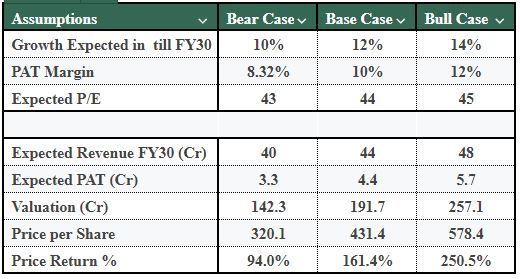
  • Zepto has achieved scale with rapid revenue increases from ₹141 crore FY22 to ₹4,455 crore FY24, but going forward is expected to have moderate, yet still strong, growth due to increased order frequency, improved dark-store utilisation and the introduction of new private labels and high-margin categories.
  • Based on industry trends and existing scale at Zepto, revenue growth projections are for an 8 to 10% CAGR until FY2030, which would mean FY30 revenues of approximately ₹6,500 to ₹7,200 crore.
  • As for profitability, loss levels will gradually narrow due to improved unit economics, optimised logistics and lower customer acquisition costs; however, while obtaining short-term profitability seems unlikely, achieving meaningful EBITDA breakeven can be expected no sooner than the medium-term, contingent upon disciplined execution.
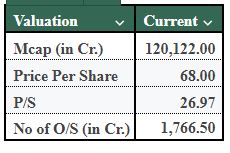
  • At current valuations (approximately 27 times price to sales ratio), future investments will be highly dependent on the execution capabilities of the Zepto team. Though an exciting concept with huge potential for long-term growth, the cash burn rates currently being realised and improvements being made in governance processes will significantly contribute towards creating long-term value for shareholders.

In conclusion, Zepto presents a high-growth/high-risk opportunity for long-term investors willing to accept volatility and delayed profitability.

Conclusion

The rapid rise of Zepto as a fast-growing Quick Commerce company in India presented a great opportunity to develop a successful business model based on revenue generation and operational efficiency. However, Zepto has only just begun to develop its business and will now focus its efforts to ensure that it grows responsibly with discipline and governance, as well as through financial integrity, which is critical to the long-term success of the company. How well Zepto meets these new challenges will ultimately dictate whether or not it continues to find success as an innovative, entrepreneurial organisation or becomes an established institution in the marketplace. For investors seeking exposure to Zepto’s growth story, the company is now available on Sharecart, providing access to this emerging opportunity.


Join the Discussion

User

UNLISTED COMPANIES

Top Unlisted Shares to Invest In

national-stock-exchange
oravel-stays-limited
policyx
metropolitan-stock-exchange-of-india-limited
polymatech-electronics-ltd
spray-engineering-devices-limited
zepto-ltd-ccps
sunday-proptech-limited
sbi-funds-management-limited
greenzo-energy-india-limited
hindustan-power-exchange-limited
cochin-international-airport-limited
orbis-financial-corporation-ltd
onix-renewable
hdfc-securities-limited
incred-holdings-limited
royal-care-super-speciality-hospital-limited
gfcl-ev-products-limited
api-holdings-ltd
motilal-oswal-home-finance-limited
honeywell-electrical-devices-and-systems-india-limited
bira-unlisted-shares
lords-mark-industries
capgemini-technology-services-india-limited
aitmc-ventures-ltd
Investor

Invest In Unlisted Companies

Independent Research Powered By - Actionable data

Investor
ARTICLES

More Insights You Can’t Miss

whatsapp