Sharescart Research Club logo
Apollo Green 66 (-10.8%)Bira 124 (-3.1%)Care Health 128 (-4.5%)Cheelizza Pizza 26 (-13.3%)CSK 264 (10.9%)Ecosure Pulpmolding 42 (0%)Electrosteel Steel 36 (-5.3%)ESDS Software 385 (-18.9%)Fusion Techstack 3.4 (-1.4%)GFCL EV 44 (0%)Goa Shipyard 3050 (0%)Goodluck Defence 308 (0%)HPX India 26 (-7.1%)Incred Holdings 160 (0%)Matrix Gas 20 (-9.1%)Motilal Oswal 11.7 (-1.7%)MSEI 4.9 (-6.7%)Nayara Energy 1300 (0%)Nnt Developers 85 (0%)NSE 1955 (-2%)Onix Renewable 68 (13.3%)OYO 23 (-6.9%)OYO Assets 25 (0%)PolicyX 58 (1.8%)Polymatech Electronics 66 (-5.7%)Ramaraju Surgical 285 (0%)RRP S4E 225 (0%)SBI Mutual 775 (0%)Schneider Electric 975 (0%)Zepto 55 (-5.2%)

15 Days Price Change

Is Fino PayTech India’s Silent Financial Inclusion Leader

Is Fino PayTech India’s Silent Financial Inclusion Leader

URVASHI TOTLA URVASHI TOTLA
URVASHI TOTLA

MBA graduate and CFA Level II cleared, with NISM certifications in Series VIII and XV. Ski... MBA graduate and CFA Level II cleared, with NISM certifications in Series VIII and XV. Skilled in Financial Modeling, Valuation, and Portfolio analysis, with a strong interest in equity research and investment strategies. Read more

13

Articles

11

Likes

9

Followers
20 Mar, 2026
Exclusive Access to Unlisted Shares
  • Early Entry Advantage
  • High-Growth Potential
  • Trusted & Secure

Summary

Fino PayTech is a financial inclusion–focused fintech platform that has evolved into a profitable, scalable business driven by its stake in Fino Payments Bank (contributing ~99% revenue). With ~21% revenue CAGR, improving margins, and a strong shift toward digital and CASA-led revenues, the company has undergone a structural turnaround and now operates with better efficiency and stability.
Despite risks like regulatory constraints and margin pressure in core segments, strong growth drivers such as digital scaling, rural distribution, and potential reverse merger position it well for the future. Available on Sharescart as an unlisted opportunity, Fino PayTech offers a compelling long-term play in India’s growing fintech ecosystem.

Company Overview

Fino Paytech was incorporated on July 13, 2006, India had hundreds of millions of people without access to formal banking services. The solution most companies chose was to wait — for incomes to rise, for smartphones to proliferate, for the cities to expand far enough that a branch made economic sense. Fino made the opposite choice entirely.

Instead of waiting, the company set out to build the technology infrastructure that could carry banking into India's most economically remote corners. Its first products were not consumer-facing at all. They were biometric smart cards and enrollment platforms sold to banks, microfinance institutions, and government bodies — picks-and-shovels tools for an industry that was only beginning to understand what financial inclusion at scale would require.

Nineteen years later, Fino Paytech is a fintech holding company with four subsidiaries, a 75% stake in a profitable listed payments bank, and a consolidated revenue base that crossed Rs.1,864 crore in FY25 — a figure that represents approximately 21% compounded annual growth from Rs.860 crore in FY21. Per the FY25 Annual Report filed July 2025, the standalone parent has also turned profitable (PBT of Rs.419 lakh after a loss of Rs.839 lakh in FY24), repaid all long-term debt, and improved its Debt Service Coverage Ratio from a deeply negative −3.48 in FY24 to a positive 10.31 in FY25. That is not a small turnaround. It is a structural one.

The business operates through a clear hierarchy. The listed subsidiary — Fino Payments Bank Limited (BSE: 543386) — contributes approximately 99% of consolidated group revenue, with FY25 turnover of Rs.1,84,710 lakh (Rs.1,847 crore) and net profit of Rs.9,253 lakh (Rs.92.5 crore). The parent holds 75% of that bank, provides the overarching technology platform and UIDAI-registered authentication infrastructure, and also houses three wholly-owned subsidiaries: Fino Trusteeship Services Limited (profitable, Rs.40 lakh PAT in FY25), FFPL Finserv Private Limited (microfinance NBFC, Rs.60 lakh loss), and Fino Financial Services Private Limited (dormant). The group in FY25 is leaner, more profitable, and structurally more defensible than at any point in its history.

The following are the main segments of Fino PayTech's technology-driven financial inclusion platform:

  • Banking & Payments (Core): Fino Payments Bank is responsible for AEPS, micro ATMs, remittances, and basic banking services.
  • Merchant Payments: assisted digital payment options and QR codes for small businesses.
  • As an ASA registered with UIDAI, Aadhaar Services offers e-KYC and authentication services.
  • Banking Technology: Banks and other institutions can use platforms and transaction processing solutions.
  • Government services include pensions, DBT, and rural subsidy distribution.

Who Actually Owns Fino —
And What Their Presence Signals

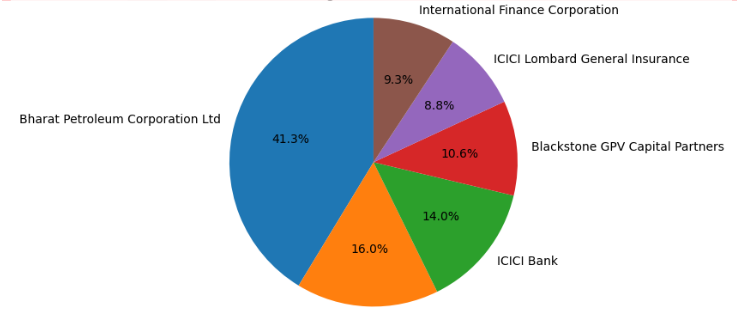
Fino Paytech's shareholder register, as disclosed in the FY25 Annual Report's notes to financial statements, is dominated by blue-chip institutional names. The company has no promoter holding — the founding shareholders have been fully diluted over successive institutional rounds. There are no Jains or Guptas listed under promoters. What remains is ownership by a state-owned oil major, India's largest general insurer, the country's largest private bank, a global private equity firm, and a World Bank group development finance institution.


What Could Go Wrong —
And Where the Real Growth Lives

Risks

CEO Arrest & Regulatory Scrutiny
The research report explicitly flags the arrest of Fino Payments Bank's CEO and reports of a potential ED probe, which caused the listed bank's shares to fall over 17%. For the parent holding 75% of that bank — with the bank investment carried at Rs.37,081 lakh on the standalone balance sheet — any material damage to the bank's operating licence or standing has direct financial consequences. This is the single most important near-term risk to monitor carefully.
 
DMT & AePS Margin Compression
Domestic Money Transfer revenue fell from Rs.45,497 lakh in FY24 to Rs.34,130 lakh in FY25 — a 25% decline in a single year. Micro-ATM revenue fell from Rs.8,254 lakh to Rs.6,376 lakh. These core BC products face structural pricing pressure as competitors proliferate and NPCI regulates commission rates. CASA and Digital growth must continue to more than offset this headwind.
 
Payments Bank Framework Constraints
No lending, deposit caps, foreign ownership limits — these are permanent structural constraints of the payments bank licence. The inability to cross-sell credit products limits the revenue per customer relationship compared to a full-service bank. Margin expansion pathways are genuinely narrow; PAT margins of 4–5% may be a structural ceiling rather than a temporary floor.
 
Reverse Merger Timeline Uncertainty
The FY24 report disclosed the restructuring proposal. As of FY25, no definitive approval has been announced. RBI consent, board approvals, and shareholder ratification are all required. For unlisted shareholders waiting for a liquidity event, timeline uncertainty is a real and ongoing overhang.

Opportunities

Digital Revenue — Rs.159 lakh to Rs.38,574 lakh in One Year
The Digital segment's jump from Rs.159 lakh (FY24) to Rs.38,574 lakh (FY25) is the most significant number in the FY25 annual report. UPI volumes, B2B digital partnerships, and merchant payment solutions are all scaling on top of an existing distribution infrastructure. Every incremental digital transaction runs at near-zero marginal cost once the merchant is enrolled and the network is active. This is where operating leverage is being built.
 
CASA as a Compounding Annuity Engine
CASA revenue grew 41% in FY25 to Rs.42,865 lakh and is now the single largest retail product line. Customer deposits grew 37% to Rs.1,94,112 lakh. This revenue renews automatically — annual subscription charges and debit card fees that are not dependent on transaction volumes. As the account base compounds, CASA provides a growing, predictable revenue floor that insulates the business from DMT and AePS cyclicality.
 
Reverse Merger — The Unlisted Premium Catalyst
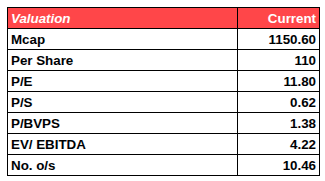
If RBI approves the group restructuring, unlisted Fino Paytech shareholders receive listed bank shares at market price — full price discovery and liquidity in one event. The Ujjivan and Equitas precedents show this process takes 12–18 months from RBI approval. At Rs.110 per share (Rs.1,150 crore market cap) against a bull-case FY30 valuation of Rs.4,526 crore, the unlisted discount to intrinsic value is substantial on any reasonable model.
 
BPCL Distribution Activation
BPCL's 26.71% equity holding and its nationwide petrol pump network represent a cross-distribution opportunity that has been largely untapped. Petrol pump operators are natural BC merchant candidates — they already have cash handling experience, daily customer footfall, and established POS relationships. A systematic activation of BPCL outlets as Fino BC points could add tens of thousands of merchant locations with minimal incremental cost.

Financial Overview:

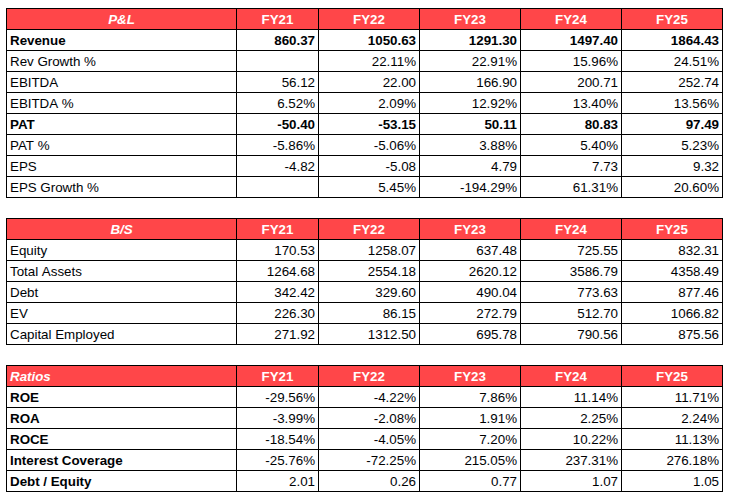
The financial picture is best understood through three lenses: the consolidated group, the standalone parent, and the bank. All numbers are sourced directly from the FY21,FY22,FY23, FY24, and FY25 Annual Reports of Fino Paytech Limited.

The consolidated revenue trajectory is unambiguous. From Rs.860 crore in FY21, the group compounded to Rs.1,864 crore in FY25 — a 21% four-year CAGR. Profitability followed and then accelerated: PAT moved from losses of Rs.50 crore (FY21) and Rs.53 crore (FY22) to profit of Rs.50 crore (FY23), Rs.81 crore (FY24), and Rs.97 crore (FY25). EBITDA followed the same arc — Rs.56 crore, Rs.22 crore, Rs.167 crore, Rs.201 crore, Rs.253 crore across FY21–FY25. The EBITDA margin expanded from 6.5% in FY21 to 13.56% in FY25 — a 700 basis point improvement that reflects genuine operating leverage in a network business where most incremental transactions flow at near-zero marginal cost once the infrastructure is in place.
Future Forecast With Assumptions:

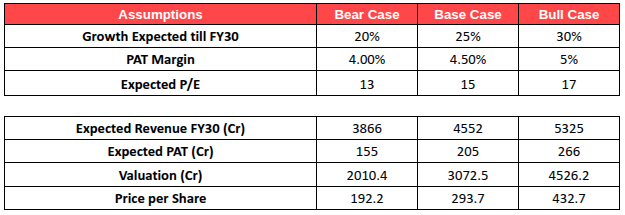
  • Industry Tailwind: Fino PayTech Limited has significant long-term growth prospects as the fintech market in India is expected to grow from $145 billion in 2025 to $550 billion by 2030 (~30% CAGR).
  • Growth Assumption (20–30%): FY30 revenue is estimated to be between 3,866 and 5,325 Cr, in line with both past performance and the growth of the fintech sector.
  • Margin Assumption (~4–5%): The FY25 PAT margin of ~5.23% supports the conservative estimate of profitability because payments banks operate on a deposit-led model without lending, which restricts margin expansion.
  • Valuation Multiple (P/E 13–17): Based on Fino Payments Bank's current valuation (~17x P/E), assuming a possible re-rating after short-term problems stabilise.
  • FY30 Valuation Outlook: Based on these assumptions, the estimated valuation ranges from ₹2,010 Cr to ₹4,526 Cr, suggesting a possible share price range of ₹192 to ₹432 in  bear, base and bull scenarios.

Peer Comparison:

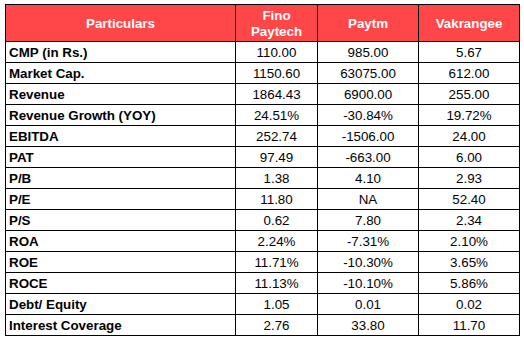
  • In comparison to proxy peers, Fino PayTech Limited reported ₹97 Cr PAT and ₹253 Cr EBITDA, whereas One 97 Communications is still losing money with negative EBITDA and PAT.
  • Better valuation comfort: Compared to Paytm (P/S ~7.8x) and Vakrangee Limited (P/E ~52x), Fino PayTech trades at P/E ~11.8x and P/S ~0.62x, which are much lower.
  • Better return ratios: Vakrangee displays comparatively lower profitability metrics, Paytm reports negative return ratios, and Fino PayTech produces double-digit ROE (11.7%) and ROCE (11.1%).
  • Healthy growth trajectory: Fino PayTech's revenue increased by about 24.5%, surpassing Paytm's declining revenue and maintaining its competitiveness with Vakrangee's growth.
  • Context of proxy peers: Since no publicly traded company precisely fits Fino PayTech's financial inclusion + payments bank ecosystem model, Paytm and Vakrangee are used as broad fintech/digital service proxy peers.

Conclusion:

Fino PayTech has evolved from a financial inclusion enabler into a scalable, profitable fintech platform with strong operating leverage and a clear shift toward higher-quality revenue streams like digital payments and CASA. Backed by a dominant stake in Fino Payments Bank, consistent revenue growth (~21% CAGR), and improving margins, the company today is structurally stronger, leaner, and well-positioned to benefit from India’s expanding fintech ecosystem—despite near-term risks around regulation and margin pressures.

From an investment perspective, Fino PayTech is available on  Sharescart as an unlisted opportunity, offering potential upside driven by digital growth, distribution expansion, and the optionality of a reverse merger. With improving fundamentals and strong industry tailwinds, it stands out as a compelling long-term fintech play in the unlisted space.

Join the Discussion

User

UNLISTED COMPANIES

Top Unlisted Shares to Invest In

national-stock-exchange
sbi-funds-management-limited
sunday-proptech-limited
policyx
metropolitan-stock-exchange-of-india-limited
incred-holdings-limited
nayara-energy
polymatech-electronics-ltd
onix-renewable
apollo-green-energy
oravel-stays-limited
motilal-oswal-home-finance-limited
goodlulck-defence-and-aerospace-ltd
schneider-electric-president-systems-limited
matrix-gas-and-renewables-limited
zepto-limited
ramaraju-surgical-cotton-mills-ltd
gfcl-ev-products-limited
nnt-developers-limited
ecosure-pulpmolding-technologies-limited
esds-software-solution-ltd
goa-shipyard-limited
hindustan-power-exchange-limited
cheelizza-pizza-india-limited
chennai-super-kings-cricket-limited
Investor

Invest In Unlisted Companies

Independent Research Powered By - Actionable data

Investor
ARTICLES

More Insights You Can’t Miss

whatsapp