15 Days Price Change
 Nikhil Singh
I am a versatile professional known for my expertise as a technical analyst, insightful co... I am a versatile professional known for my expertise as a technical analyst, insightful contributions as a part-time investor, and creative talents as a content writer. With a strong background in finance, I seamlessly combine technical know-how and fundamental analysis in my role as a part-time investor. Read more
Summary
The article compares Signify Innovations India with major competitors like Havells Crompton and Bajaj Electricals by focusing only on their lighting businesses. While these companies earn most of their growth from appliances or other products their lighting divisions show slow growth and lower margins. Signify on the other hand generates over 3100 crore revenue mainly from lighting and still maintains strong profitability and very high return on capital. This shows the company operates at a much stronger level in the lighting sector and does not depend on other product categories to support earnings.
Signify Innovations India Limited (formerly Philips Lighting India) is the Indian subsidiary of global lighting leader Signify Netherlands. The company operates across consumer lighting and professional lighting systems and increasingly focuses on connected and smart lighting solutions.
Why the business stands out
More than ₹3100 crore revenue generated almost entirely from lighting
Premium smart lighting ecosystem (Hue + Interact platform)
High return on capital with asset-light manufacturing model
Strong cash generation and debt free balance sheet
Beneficiary of smart city and infrastructure expansion
| Positive Factors | Risk Factors |
|---|---|
| Premium product mix protects margins | Falling prices in basic LEDs |
| Asset-light manufacturing via Dixon JV | Royalty payout to parent |
| High return on capital | Raw material price volatility |
| Growth from smart infrastructure projects | Competitive consumer segment |
| Strong brand and technology access | Parent company cash extraction risk |
Detailed breakdown of business segments
Signify Innovations India works mainly in two business areas.
| Segment | Description | Key Products |
|---|---|---|
| Consumer ( B2C ) | Household lighting products | LED bulbs, battens, downlights, Philips Hue, EcoLink |
| Professional ( B2B ) | Commercial & infrastructure solutions | Architectural lighting, Interact smart systems, entertainment lighting |
The company follows a three-part strategy:
Grow in smart connected lighting and specialized solutions
Stay competitive in low-cost mass products
Generate steady cash flow from traditional lighting
Manufacturing scale is outsourced to Dixon Technologies while the company focuses on software driven lighting and premium products.
SIIL maintains a ubiquitous pan-India distribution network, commanding a massive footprint in both urban and rural domestic markets. Furthermore, its geographic significance is expanding globally; under the corporate "China Plus One" supply chain strategy, the Indian subsidiary is increasingly viewed as a highly competitive manufacturing and export hub specifically engineered to serve Signify’s expansive global supply chain requirements.
Revenue Streams
The company generates revenue through two primary streams:
This remains the highest volume contributor, encompassing the mass-market sales of LED fixtures, smart bulbs, and professional luminaires.
In FY24, the gross sale of products stood at ₹2,646 Crores.
Representing a strategic pivot to combat hardware price erosion, SIIL sells highly lucrative software integration, maintenance, and IoT connected services (such as the Interact platform).
This stream generated ₹416 Crores in FY24, showing steady year-over-year growth.
Market size and growth potential
The lighting market in India is getting bigger very quickly. This is happening because cities are getting bigger and new buildings are being made. In 2024 the lighting market in India was worth about 14.1 billion dollars. It is expected to reach around 22.4 billion dollars by 2030. The lighting market in India is growing at 8.6 percent every year.
The lighting market in India has a part called lighting. Smart lighting is growing faster than any part of the lighting market in India. This is because buildings are using automation and connected systems. Smart lighting is expected to grow fast over the next few years. This is because IoT based controls are becoming very common in the lighting market in India.
Industry trends
Shift from hardware bulbs to connected lighting systems
Government push for domestic manufacturing
Falling prices in basic LEDs forcing premiumization
Demand for energy efficient infrastructure lighting
Local manufacturing push
The government is helping companies make things in India. They are making things like LED chips and drivers in India. This means India does not have to import many things. It is also making the supply chain in India stronger.
Falling hardware prices
Basic LED products are very common now. They are also very cheap. This means companies are not making much money from them. So companies are focusing on making premium products. They are also focusing on software based solutions. They are not just selling hardware anymore.
Competitive landscape
| Company | Business Dependence | Lighting Performance |
|---|---|---|
| Crompton | Fans & appliances driven | Lighting margin ~10.7% |
| Havells | Lloyd appliances growth driver | Lighting stagnant |
| Bajaj Electricals | Consumer products dependent | Weak margins |
| Signify | Pure lighting focused | High profitability & capital return |
Signify generates over ₹3100 crore revenue primarily from lighting while peers rely on other categories.
Promoter background
Signify Innovations India is backed by Signify Holding from the Netherlands which is part of the global lighting company Signify. The parent company is known as one of the world leaders in lighting technology and invests heavily in research and intellectual property. Because of this the Indian business gets direct access to advanced lighting innovations and new technologies much earlier than most local competitors.
Sumit Padmakar Joshi
He works as Vice Chairman Managing Director and CEO. During his leadership the company moved strongly toward smart IoT based lighting and also formed important local manufacturing partnerships.
Vinayak Kashinath Deshpande
He is the Chairman and Independent Director and mainly focuses on governance and oversight of company decisions.
Dibyendu Raychaudhury
He serves as Whole time Director and Chief Financial Officer and manages financial discipline while keeping the company debt free.
Vikas Malhotra
He is a Whole time Director who leads the systems and services business which is one of the most profitable parts of the company.
The management follows a clear multi step strategy. They want to grow strongly in specialized lighting and smart connected lighting solutions stay competitive in low cost basic products and keep earning steady cash from traditional lighting products. To maintain efficiency the company outsourced large scale manufacturing to Dixon Technologies through a joint venture. This lets the company invest more into software driven lighting and premium direct to consumer products instead of heavy factory assets.
Ownership structure
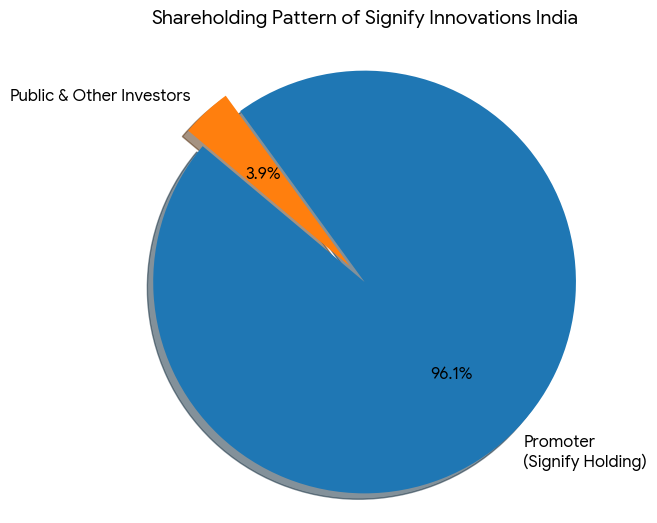
Signify Innovations India has a highly concentrated shareholding pattern which is common for subsidiaries of large multinational companies. The company has a total of 5,75,17,242 equity shares and each share has a face value of 10 rupees.
The promoter Signify Holding from the Netherlands owns around 96 percent of the company which means about 5,52,90,242 shares are under promoter control. Only a small portion around 3.8 percent is held by public and other investors. These roughly 22 lakh shares are traded in the unlisted secondary market by retail and institutional buyers.
Private equity and venture capital involvement
Since the company is part of a large global group it does not depend on private equity or venture capital funding. The business generates strong internal cash flows which are enough to manage operations and expansion without diluting ownership or taking major debt.
Recent funding activity
The main company has not raised fresh external capital recently. However in March 2025 when it formed the joint venture Lightanium Technologies with Dixon Technologies the partner invested 2.5 crore rupees for a 50 percent stake by subscribing to 25 lakh shares at 10 rupees each in the new manufacturing entity.
The world is moving toward smart energy saving and connected lighting systems and because of this the lighting and electrical products industry is changing fast. In this situation India has become a very important market. The growth is coming from a large population fast urban development infrastructure projects and strong government support for local manufacturing and energy efficiency. In 2024 the Indian lighting market generated about 14.1 billion dollars and it is expected to grow steadily to around 22.4 billion dollars by 2030. India already holds about 9.3 percent share of the global lighting market which makes it one of the fastest growing regions in Asia Pacific.
Signify Innovations India Limited has built a competitive advantage by moving beyond normal lighting and creating connected technology based environments. As simple LED bulbs became cheaper and profit margins dropped across the industry the company shifted toward hardware combined with software to protect profitability and offer higher value solutions.
In the business segment the company relies on its Interact platform which is a smart connected lighting system designed for offices buildings and city infrastructure.
The company has also introduced LiFi technology where light carries internet data which can be useful in high security environments.
In the consumer market the company leads the smart home segment through the Philips Hue range which includes smart bulbs light strips ceiling lights and lamps connected through a central hub and controlled by mobile apps or voice assistants.
A detailed review of Signify Innovations India Limited’s financial records over the last few years shows the company is financially strong and consistently generates cash. Even though the lighting industry has faced falling product prices the company has protected its profits mainly because it focuses on premium products and services instead of only selling hardware.
Looking at the past five years the company has handled supply chain problems inflation and heavy competition quite well.
All figures are in Crores (₹)
| Metric | FY21 | FY22 | FY23 | FY24 | FY25 | CAGR |
|---|---|---|---|---|---|---|
| Net Sales | 2502.5 | 2794.6 | 3106.3 | 3068.7 | 3113.6 | 5.6% |
| Total Income | 2515.7 | 2824.4 | 3129.6 | 3097.9 | 3142.7 | 5.7% |
| Net Profit | 267.6 | 231.9 | 266.7 | 269 | 270.1 | 0.2% |
| EPS | 46.53 | 40.32 | 46.37 | 46.77 | 46.96 | Stable |
Profit & Loss Performance
FY 25 Financials (₹ in Crores)
| Metric | FY 2024-25 | FY 2023-24 |
|---|---|---|
| Revenue | 3,114 | 3,069 |
| Other Income | 29 | 29 |
| Total Income | 3,143 | 3,098 |
| Total Expenses | 2,770 | 2,728 |
| Profit Before Tax | 366 | 365 |
| Tax Expense | 96 | 96 |
| Net Profit (PAT) | 270 | 269 |
Cash Flow Statement (₹ in Crores)
| Category | FY25 | FY24 |
|---|---|---|
| Operating Cash Flow | 366 | 325 |
| Investing Cash Flow | (28) | (5) |
| Financing Cash Flow | (551) | (513) |
| Net Change in Cash | (213) | (193) |
| Closing Cash Balance | 246 | 458 |
Cash Flow Analysis ( ₹ in Crores )
| Particulars | FY25 | FY24 | Change |
|---|---|---|---|
| Current Ratio | 12 | 13 | −2% |
| ROE | 55% | 45% | +22% |
| PAT Margin | 8.7% | 8.8% | −1% |
| ROCE | 69% | 55% | +26% |
| Debt-Equity Ratio | 29% | 24% | +23% |
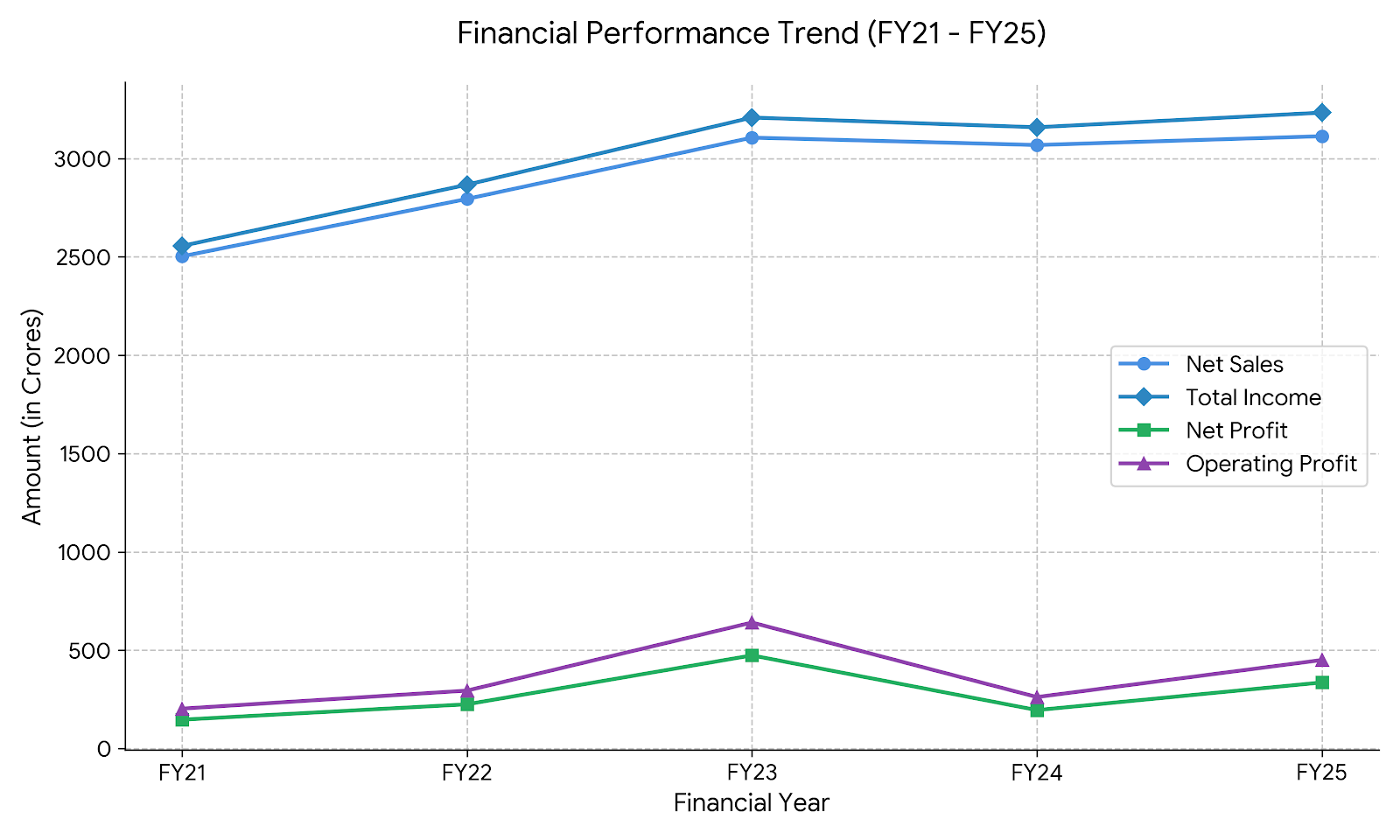
source - https://www.signify.com/global/our-company/investors/financial-reports/annual-report
Revenue remained largely stable despite pricing pressure in the LED industry. FY25 growth was modest as the company operated in a competitive environment with falling product prices. Service income increased to ₹416 crore from ₹343 crore which supported overall performance when product sales slowed.
One important detail in the company’s finances is the royalty it pays to its global parent company. Signify Innovations India sends a large technical royalty every year to Signify Netherlands for using the brand technology and intellectual property. Past records show these payments are usually between 115 crore and 123 crore rupees annually.
When you compare this with the company’s net profit of around 270 crore the impact becomes clear. More than 40 percent of the profit is effectively paid out before tax as royalty. So a big share of the value created in India goes back to the parent company.
This gives two useful insights. First the parent company gets steady cash support from India especially when its European business faces slow growth and cost cutting pressure. Second the Indian company’s real profitability looks lower than it actually is because a large expense is booked as royalty. If this payment did not exist the operating profit and final earnings would be much higher which shows the strong earning power and pricing strength of the business in the region.
Revenue stable at ~₹3100+ crore with ~5–6% long-term growth trend
Net profit stable around ₹270 crore indicating consistent earnings base
EPS largely flat over five years showing mature but predictable business economics
High return on capital supported by asset-light manufacturing model
Profitability understated due to ₹115–123 crore annual royalty payout to parent
Significant portion of economic value transferred outside India before final earnings
Service income growth partially offsets hardware price compression
Pure lighting focus unlike peers whose valuations depend on appliances or fans
Margin stability despite commoditization suggests pricing power in premium segment
Cash generation supported by low capital requirement structure
JV manufacturing reduces need for balance sheet expansion
Earnings quality dependent on parent company royalty structure
| Company | Lighting Performance | Business Dependence |
|---|---|---|
| Crompton | ~₹253–276 Cr lighting revenue, ~10.7% margin | Supported by consumer products |
| Havells | ~₹436 Cr lighting revenue, largely flat | Growth driven by Lloyd appliances |
| Bajaj Electricals | ~₹271 Cr lighting revenue, weak EBIT | Dependent on lower price products |
| Signify | ~₹3100+ Cr lighting revenue, ~8.7% net margin | Pure lighting focused |
Signify formed a 50:50 joint venture with Dixon Technologies in March 2025 called Lightanium Technologies.
Purpose:
Local manufacturing of lighting products
Support China Plus One supply chain
Reduce capital investment in factories
Dixon invested ₹2.5 crore in the entity while manufacturing scale is handled by the partner and the company focuses on premium and software driven lighting.
Signify Innovations India stands in a very strong position within the Indian lighting industry. The company is not just selling bulbs anymore it is building smart lighting ecosystems for homes, offices and cities. Its focus on connected technology, premium products, and software based solutions helps protect margins even when basic LED prices keep falling.
The partnership with Dixon through Lightanium Technologies strengthens its manufacturing base and reduces cost pressure while allowing the company to stay asset light and maintain high returns on capital. At the same time the backing of a global parent gives it access to advanced technology, strong brand value, and deep research capabilities.
There are risks like competition, price pressure, and global economic uncertainty. The company has shown it can manage these challenges. It does this with a clear strategy. The company deals with competition well and handles price pressure and global economic uncertainty too. With India moving toward smart infrastructure, sustainable energy use, and urban expansion, Signify is well positioned to benefit from long term growth opportunities. Overall the company reflects a mix of stable profitability, strong governance, technological leadership, and future ready positioning, which makes it one of the most structured and resilient players in the Indian lighting sector.
Note: This is a research article and we do not claim or guarantee anything. The data has been taken from Sharescart and Signify’s Annual Report.












Independent Research Powered By - Actionable data

Comprehensive Equity and Strategic Research Report...
February 2026
Apollo Green Energy Limited: Comprehensive Equity ...
February 2026

Excelsoft Technologies : Should you invest?
November 2025
The Booming India EV Industry : Where Future Lies ...
September 2025
Shakti Pumps: Powering Sustainable Solutions for a...
September 2025
Polycab India: A Rising Giant
August 2025
Difference between Stock Market and Share Market
February 2025